
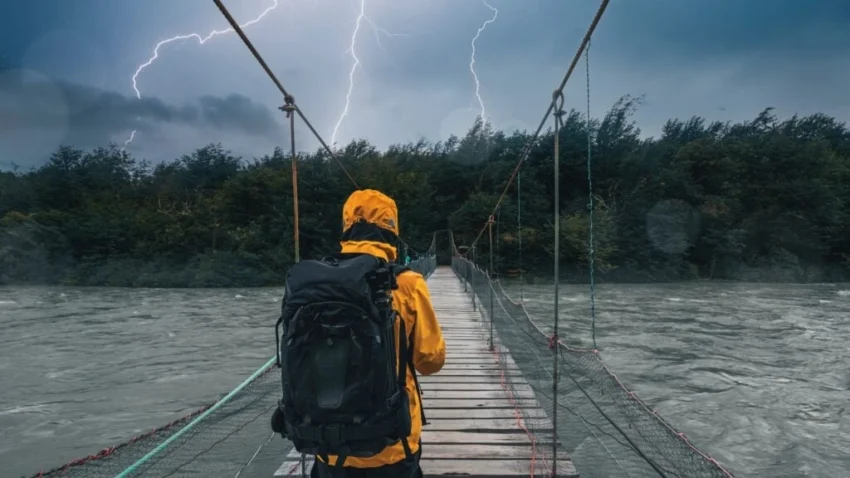
Wild weather can ruin a camping trip; it can also make for the powder ski weekend of your dreams. Our columnist discovered hacks that will guide the timing of your vacation plans.
New perk: Easily find new routes and hidden gems, upcoming running events, and more near you. Your weekly Local Running Newsletter has everything you need to lace up!
There’s nothing worse than being skunked by the weather on a trip. My first foray to Thailand coincided with a typhoon. I visited in November, typically the end of the country’s rainy season, but my entire week in Koh Samui was one big downpour.
The extremes of climate change—from increasingly intense heat waves to more frequent polar vortexes—have made travel feel like a constant gamble, no matter the time of year. This year’s Atlantic hurricane season, which runs from June through November, blew in like a lion with Beryl, the earliest category-five Atlantic hurricane on record, and experts warn that a record-setting string of storms will likely hit the East and Gulf Coasts in the coming months.
Although technology is improving, it’s still impossible to predict the weather with 100 percent accuracy. Global forecaster AccuWeather makes projections up to 90 days out, but specific, precise daily reports cannot be made more than ten days in advance, according to a 2019 study published in the Journal of the Atmospheric Sciences. Given the chaotic nature of the atmosphere, two weeks out is probably the farthest accurate estimate we can hope for in the future.
So where does that leave travelers who plan ahead? Is there more we can do than just book a trip and hope for the best? Yes! Several companies have begun offering smart options for outdoor adventurers, designed to provide peace of mind and protection when agenda-altering weather strikes. These are my favorites.
“Some people are fine camping in the rain,” said Alyssa Ravasio, founder and CEO of Hipcamp, a booking platform for more than 120,000 campsites on private land across the U.S. “But most aren’t looking for a soggy outdoor experience.”
She and her team noticed that inclement weather created an awkward situation between campsite hosts and guests. On such occasions, when guests were outside of the refund window, sometimes hosts would feel bad about the weather and offer refunds. Or if they didn’t, campers became upset, she said.
Hipcamp introduced a system ensuring hosts don’t have to choose between the satisfaction of their guests and their own financial stability. This initiative stemmed from their collaboration with Sensible Weather, established in June. Sensible Weather, a company specializing in weather predictions since four years, collaborates with over 4,000 reservation platforms, including ones focused on campsites like KOA, Outdoorsy, and Travel America, as well as various resorts catering to hospitality, skiing, and golfing activities. They enable the integration of a weather-guarantee refund option—guaranteeing refunds up to the full payment—that customers can opt into during booking.
The price for this insurance varies, influenced by the destination, season, and total expenditure of the trip, normally averaging about 10 percent of the reservation cost. It not only covers heavy rain but also extreme conditions like intense heat and snow.
For instance, suppose you book a three-day stay through Hipcamp for $300 and decide to purchase Sensible Weather protection for an additional $30. This cover might include conditions like reimbursing if it rains over three hours cumulatively each day from 8 AM to 8 PM. The tolerance for triggering refunds is specified by daily weather predictions from esteemed agencies such as NOAA and NASA. If it ends up raining for four hours on one of the days, Sensible Weather would refund you $100.
Reimbursements are processed automatically on the day bad weather is recorded, through digital payment methods like PayPal, and typically take three to five days to be received. There’s no requirement to file a claim or cancel your plans. Even if you decide to endure the rainy conditions, you might get the full cost of your vacation refunded by Sensible Weather. This model also ensures that Hipcamp hosts do not encounter any financial losses.
According to Ravasio, 14 percent of Hipcamp users who book tent sites over 30 days in advance are now opting for the Sensible Weather guarantee with their bookings. Additionally, 6 percent of all Hipcamp patrons, including those reserving RV sites and cabins, are selecting this weather protection.
The new application, WeatherPromise, provides a similar weather-related guarantee for travelers, utilizing AI to forecast climatic conditions. It targets individuals planning trips more than two weeks ahead, offering reimbursements for costs associated with airfare, accommodations, and activities if rainfall exceeds certain thresholds. WeatherPromise’s technology evaluates numerous similar travel itineraries, analyzes 55 terabytes of data, and then recommends a “promise” fee — the cost paid to the company for insuring against rain spoilage.
WeatherPromise co-founder, Dan Price, states that the application can quickly calculate an estimated fee for coverage, which typically ranges from 3 percent to 8 percent of the overall trip cost. For instance, I input data for a $600 holiday in Vail, Colorado from September 4 to 7, and the app proposed a $45 promise fee. Similarly, for a $2,500 excursion in Paris from September 22 to 28, the fee suggested was $150.
Exploring options during the Caribbean hurricane season, I considered a $2,000 trip to Puerto Rico from October 21 to 25. WeatherPromise would charge me $120 for coverage. If it rained for at least four cumulative hours between 8 A.M. and 8 P.M. over a minimum of three days during my four-day journey, I would be eligible to claim a full reimbursement of $2,000, upon submitting the cost proof of my trip.
“With WeatherPromise, hurricane season is arguably the best time to travel, because flights and accommodations are typically less expensive and crowds are smaller,” noted Price. And now, if the worst weather happens, you can get your money back.
Although the company primarily offers its services independent of booking platforms, it has partnered with the vacation-rental marketplace HomeToGo. Similar to Sensible Weather, rain is the focus, but the company is looking to expand to heat, snow, and wind (a key factor for anyone planning surf and kitesurfing trips).
Nothing ruins a ski vacation faster than no snow, and scoring a powder day can feel like winning the lottery in these climate-challenged times. But diehard skiers and snowboarders have discovered some tricks to line up trips with epic conditions.
In the early aughts, Mike Ruzek, a financial planner and avid skier based in Park City, Utah, had a client clue him in to NOAA weather buoy station 51101 thousands of miles west in the Pacific Ocean that surfers were using as an alternative to wave-forecast sites like Surfline, to estimate how big swell would get by the time it hit the Hawaiian Islands. The client, who split his time between Maui and Park City, believed the buoy’s movements correlated to storm cycles in Utah’s Wasatch Range.
Curious, Ruzek did some research and discovered that when the buoy went from floating on swells of around 5 to 15 feet—the point which followers described it as “popping”—a storm would usually hit the Wasatch 12 to 14 days later.
Ruzek doesn’t have a background in meteorology, but he knew that low-pressure systems tend to yield the most snow in winter. “When a low-pressure system rolls in [across the Pacific], it forces the water upward, making the buoy pop,” he theorized. “About two weeks after a spike in the buoy’s wave height, Utah receives a significant snowfall.”
Initially, Ruzek started observing the buoy to plan strategic ski days off work, discovering its surprising accuracy. In 2013, he created a Facebook page titled The Powder Buoy to share these predictions, followed by an Instagram account which now has over 43,000 followers.
A spokesperson from NOAA stated that the agency has not recognized a direct correlation between specific buoy measurements and this distant weather phenomenon. However, Ruzek’s observations hold merit. I consulted with Steven Businger, a meteorology professor at the University of Hawaii, who verified that the gradual movement of large planetary waves in the jet stream often leads to extended, consistent weather patterns, which can be accurately forecasted for regions more than ten days in advance.
Last year the buoy was 80 percent accurate in forecasting snow conditions in Utah, according to Ruzek, and he’s received feedback from skiers using its predictions up to 12 to 14 days in advance for Colorado and Wyoming. “In one mountain town in Colorado, a coffee shop displays our reports on a chalkboard,” he remarked with pride. Despite the potential to charge, Ruzek prefers to keep the service free, pointing out that the skiing industry is already highly commercialized.
Steve Conney also provides free winter-weather information through his project, Powderchasers. Originally from New York, he began delivering snow forecasts for U.S. ski resorts to a small group of friends over twenty years ago, before such information was accessible online. “I used to have contact numbers for snowplow drivers and workers at the Eisenhower Tunnel in Colorado,” he shared. “I would call the staff at Baked in Telluride because they were up early at 5 A.M. and could provide first-hand snow reports.”
Today, Powderchasers boasts nearly one million followers on Instagram, and continues to offer detailed, sponsor-supported forecasts for free. Their updates are engaging and enthusiastic, as seen in a recent headline from August 2nd: “EPIC ALERT: Snow Returns for South America. 3+ Feet Predicted.”
Conney now leads a dedicated team passionate about weather. “We use the same models as everyone else, but we tailor our analysis to what skiers and snowboarders are looking for,” he explained. “It’s not just about tracking the most snowfall. We also consider factors like wind, potential closures, snow density, and other elements crucial for planning the best snow pursuits.”
If you’d prefer more in-depth, personalized forecasts and custom trip planning, the company offers concierge packages that start at $149 for a single trip and go up to $699 for eight trips. “This is tailored for those enthusiastic individuals who can only make it to the slopes once or twice a year for their major ski vacations,” he mentioned.
Jen Murphy, who divides her time between Colorado and Maui, now depends on The Powder Buoy to monitor both swell and snow.